

Google Search had a busy month, and not the quiet kind.
The July 2026 Google Webmaster Report pulled together several major search developments from the past few weeks, with the June 2026 spam update sitting right at the center. That update rolled out in only two days, but its impact looked bigger than the short timeline suggested. Some ranking movement even appeared to start before the official release, which made the whole thing feel messier for SEOs watching their traffic charts.
For website owners, this was not just another routine Google update. It was another reminder that search visibility now depends on more than keywords, backlinks, and clean technical SEO. AI search, content quality, Search Console reporting, spam systems, local features, and publisher visibility are all moving at once.
Google’s June 2026 Spam Update Took the Spotlight
The biggest story in the report was Google’s June 2026 spam update. It finished rolling out quickly, but the search community still saw major volatility around the same period. Search Engine Roundtable noted several unconfirmed ranking swings during the month, including movement around June 6, June 8 to 12, and June 19.
That matters because spam updates are not always limited to obvious spam websites. Sometimes they shake up sites using aggressive SEO tactics, thin content strategies, recycled material, or pages built more for search engines than people.
And yes, that phrase gets repeated a lot. “Write for people.” But in 2026, it is no longer just a nice SEO slogan. Google’s systems are getting better at spotting shortcuts. Or at least trying to.
Google Keeps Pushing the “Great Content” Message
Google’s Head of Search, Liz Reid, said the company wants great content to shine in Google Search. That sounds simple. It is also the same problem publishers and site owners keep wrestling with: what does “great” actually mean when AI summaries, zero-click searches, and ranking volatility keep changing the traffic equation?
The report also pointed to Google discussions around chunking, site signals, content, paywalls, and AI clicks. These are not small side topics anymore. They sit right inside the modern SEO problem. A strong website now needs useful content, clear structure, authority signals, and a strategy for how its pages appear across traditional search and AI-driven results.
Google also updated guidance around SEO advice from third-party tools and services. In plain English: do not blindly trust every SEO score, AI optimization promise, or automated audit that tells you your site is broken.
That part feels overdue.
LLMS.txt Is Not a Magic SEO Button
One interesting detail from the report: Google said LLMS.txt files will not help or hurt rankings in Google Search.
That may disappoint people hoping for a quick AI-era SEO trick. But it also clears up some confusion. Website owners have been looking for ways to manage how AI systems access or understand their content. LLMS.txt has been discussed as one possible signal for large language models, but for Google Search rankings, Google is saying not to treat it as a ranking lever.
So no, adding one file will not suddenly push a website higher.
The boring stuff still matters. Crawlability. HTML. Useful pages. Real authority. A site that does not feel like it was assembled from recycled search prompts.
Search Console Gets More AI Reporting
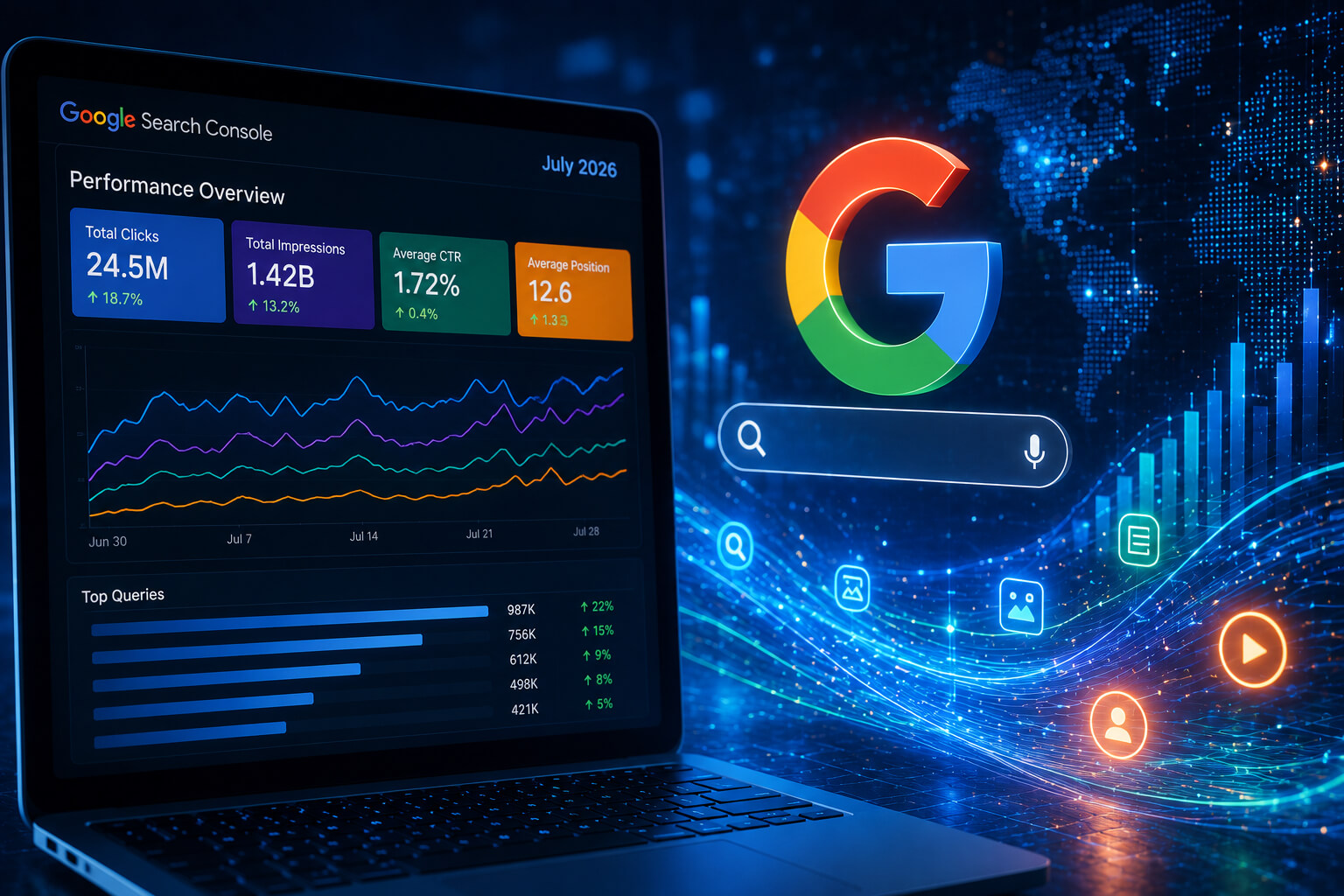
Google Search Console also had a busy month. Google expanded access to AI performance reports and published deeper documentation around generative AI controls.
This is one of the more important shifts for publishers. For years, website owners tracked search traffic mostly through clicks, impressions, queries, and page performance. Now AI search features are changing how users discover information before they ever visit a website.
AI performance reporting gives site owners more visibility into that layer, although it is still early and not always clean. The report also mentioned a generative AI reporting bug on June 24, plus other delays and outages inside Search Console reports.
Helpful? Yes. Perfect? Not yet.
Search Console Link Reports Were Fixed
Google also fixed and updated the Search Console link report, according to the July report. That will matter for SEOs who still rely on Search Console to understand internal and external link signals.
Links are not the whole SEO story anymore, but they are not dead either. Site owners still need to know which pages attract links, where authority is flowing, and whether important pages are being ignored.
The problem is that Search Console data can sometimes lag, break, or shift without much warning. This month was another example of that. The link report fix was welcome, but the page indexing report also faced delays again.
That is the current SEO reality: you need the data, but you also need patience with the tools giving it to you.
Google Search Profiles Are Now Officially Live
Another notable update was the launch of Google Search Profiles, with analytics and insights following quickly after.
For publishers, this could become another visibility surface inside Google Search. Profile-style pages may help users understand who is behind certain content, especially as trust, authorship, and source identity become more important in AI-heavy search results.
It is still too early to say how much traffic or authority these profiles will drive. But Google clearly keeps experimenting with ways to make sources, publishers, and entities more visible inside Search.
Or at least more organized.
AI Overviews and AI Mode Keep Changing the Search Page
Google also tested and rolled out several AI-related search interface updates during the month. The report mentioned AI Overviews testing a button to go only to web results, a Top Stories carousel inside AI Overviews, citation counts and favicons in AI Mode, and an “Ask Anything” box with autocomplete.
This is where website owners should pay attention.
Search is not just ten blue links. It has not been for years. But now the change is sharper. AI Overviews and AI Mode can reshape how users see sources, how they click, and how much traffic actually reaches publishers.
A citation inside an AI answer might help visibility. It might also reduce the need for a click. Both things can be true.
That is what makes this phase uncomfortable for publishers. Google is giving websites new surfaces, but also changing the old traffic model at the same time.
Local Search and Google Business Profiles Also Got AI Features
The report also covered several Google Business Profile and local search updates. Gemini can now help with Google Business Profiles, Google is preparing a connection between Business Profile and Google Analytics, and Business Profiles added a message button with an AI agent.
For local businesses, this matters a lot. AI is not staying inside general search results. It is moving into customer messaging, business listings, maps, reviews, and local discovery.
That means local SEO is becoming less about only ranking in the map pack and more about how a business appears, responds, and converts across Google’s growing local ecosystem.
A half-filled profile is going to look worse in this environment.
Regulators Are Still Watching Google Search
The report also noted that the UK Competition and Markets Authority ordered Google to share more about how its rankings work, along with data portability requirements. It also referenced an updated zero-click search report showing that open web clicks remain under pressure.
This part should not be ignored.
Google is not only dealing with SEOs and publishers. It is dealing with regulators, competitors, AI companies, advertisers, and users who are changing how they search. Every update now lands inside a bigger argument about search power, publisher traffic, AI answers, and the future of the open web.
What Website Owners Should Take From the July 2026 Report
The July 2026 Google Webmaster Report makes one thing clear: website owners cannot treat SEO as a static checklist anymore.
The spam update shows that Google is still tightening its systems. The Search Console changes show that AI visibility is becoming measurable, even if imperfectly. The LLMS.txt clarification shows that not every AI-era idea becomes an SEO factor. And the continued testing around AI Overviews, AI Mode, Search Profiles, and local AI features shows that the search results page is still being rebuilt in public.
For publishers and businesses, the safest direction is not flashy. Build pages that are useful. Keep technical SEO clean. Watch Search Console closely. Track AI search visibility where possible. Strengthen brand and author signals. Stop chasing every new file, trick, or optimization trend that appears on social media for three days.
Google Search is changing fast again.
Actually, it never really stopped.