

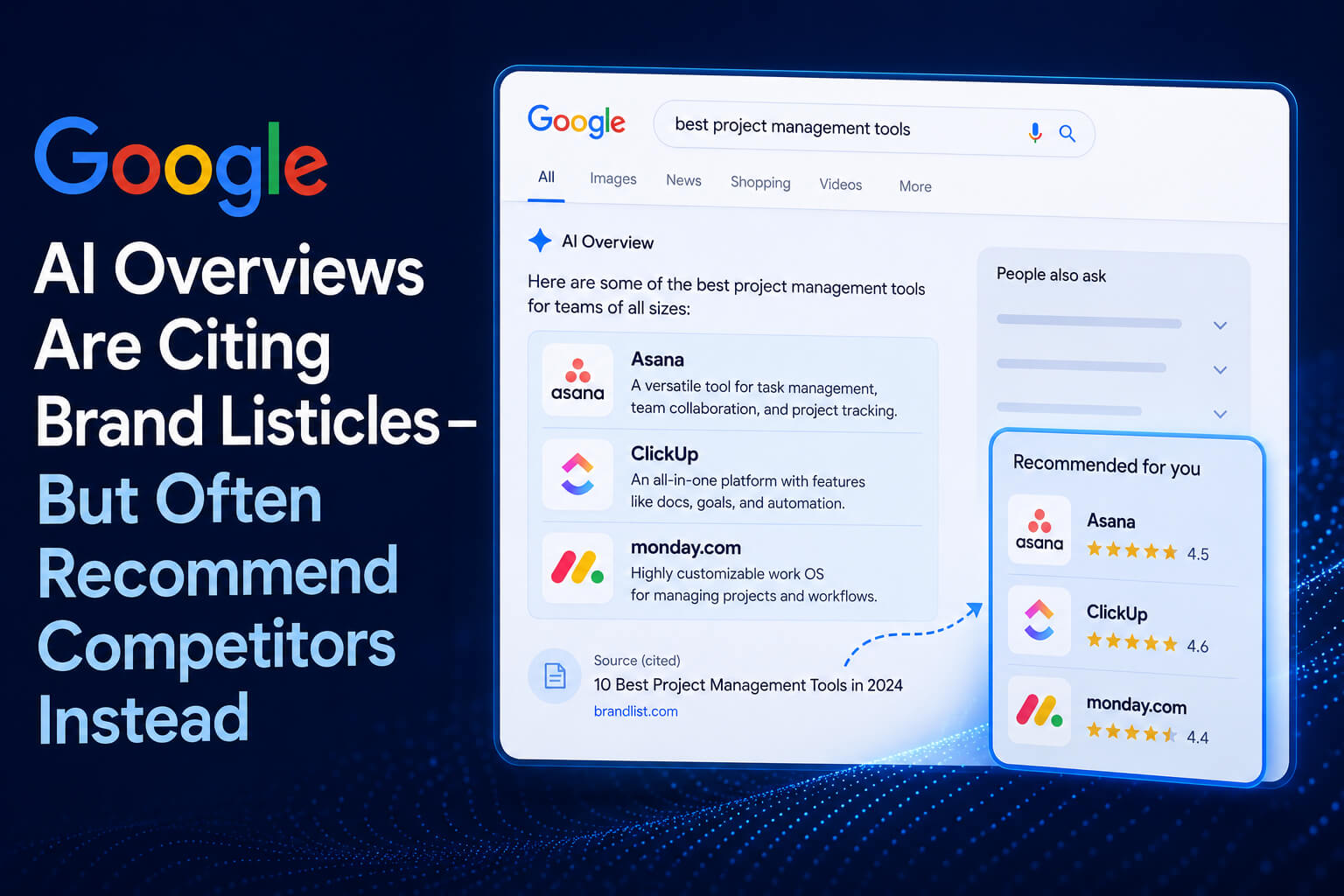
Google AI Overviews are becoming a major concern for brands that rely on search traffic, especially companies publishing “best software” and comparison-style content. A new analysis suggests that simply being cited by Google’s AI-generated answers does not always mean a brand is being recommended.
According to research from SEO expert Lily Ray, Google AI Overviews frequently cite self-promotional listicles created by brands, but in many cases, the AI response recommends competing companies instead. This finding highlights a growing challenge in AI search: visibility and influence are no longer the same thing.
What the study found
Ray analyzed 100 B2B software-related searches using the format “best [category] software.” These searches were reviewed across multiple dates between April and June 2026.
The results showed that many AI Overviews cited brand-owned listicles as sources. However, those same brands were often left out of the final recommendations. In other words, Google’s AI system appeared to use a company’s own content to support an answer, while giving the recommendation spotlight to competitors.
The study found that out of 80 prompts that triggered an AI Overview, self-promotional listicles were cited hundreds of times. In many cases, the brand behind the cited article was not included among the recommended options.
Why this matters for SEO and AI search
For years, brands have used comparison pages and “best tools” articles to influence search results. A software company might publish a list of the best products in its category and place its own brand at the top. This strategy worked well in traditional SEO because ranking the article could drive clicks, leads, and brand awareness.
AI Overviews change that equation.
Instead of sending users directly to a ranked article, Google may summarize information from multiple sources and present its own answer at the top of the results page. If Google cites a brand’s article but recommends other companies, the original publisher may lose the most valuable part of the search journey.
This creates a serious issue for marketers: being used as a source does not guarantee being chosen as the answer.
Competitors may benefit from your content
One of the biggest takeaways from the report is that brand-created listicles can unintentionally help competitors. If a company writes an article naming rival products, Google’s AI system may extract those competitor names and include them in its recommendations.
That means a brand could invest time and money into creating AI-focused SEO content, only for that content to strengthen competitors’ visibility in Google AI Overviews.
This is especially important for SaaS, B2B, CRM, help desk, task management, survey, learning management, and SEO software companies that depend heavily on comparison keywords.
Strong brands still have the advantage
The analysis also suggests that brands with stronger authority are more likely to be recommended. Companies that are widely mentioned across third-party websites, review platforms, user-generated content, and trusted industry sources may have a better chance of appearing in AI Overview recommendations.
This means AI search optimization is not only about publishing more content. It is also about building a stronger brand presence across the web.
Google appears to be looking beyond a single company-owned page. It may give more weight to broader signals such as independent mentions, backlinks, reviews, and trusted third-party references.
Third-party sources are becoming more important
The report also found that Google AI Overviews often rely on third-party websites and user-generated content for “best” queries. Sites like Forbes, Reddit, and YouTube were among the commonly cited sources in AI-generated answers.
This trend shows that Google may prefer sources that appear more independent or community-driven, especially when users are searching for product recommendations.
For brands, this means reputation outside their own website is becoming more valuable. Customer discussions, expert reviews, video content, and credible third-party mentions may now play a bigger role in AI search visibility.
What brands should do next
Brands should rethink how they create comparison and “best” list content. Publishing self-serving articles may no longer be enough, and in some cases, it could even help competitors.
Instead, companies should focus on creating genuinely useful content that explains product strengths clearly, supports claims with evidence, and avoids overly promotional ranking tactics.
They should also invest in broader brand authority. This includes earning independent reviews, building high-quality backlinks, encouraging authentic customer feedback, and increasing mentions across trusted industry sources.
The key lesson is simple: AI search rewards more than content volume. It rewards trust, authority, and widespread recognition.
The bigger picture
Google AI Overviews are changing how users discover brands online. Traditional SEO focused heavily on ranking pages and earning clicks. AI search is more focused on answers, recommendations, and summarized visibility.
For businesses, this means the future of SEO will require a stronger connection between content strategy, brand reputation, and third-party validation.
Being cited in an AI Overview is useful, but being recommended is far more valuable. As Google continues to expand AI-powered search, brands will need to optimize not just for rankings, but for trust and selection.
Final thoughts
The rise of Google AI Overviews is forcing marketers to rethink old SEO strategies. Self-promotional listicles may still get cited, but they do not guarantee brand visibility where it matters most.
For companies competing in crowded software categories, the goal should not be simply to appear in AI search. The goal should be to become the brand Google’s AI systems trust enough to recommend.