

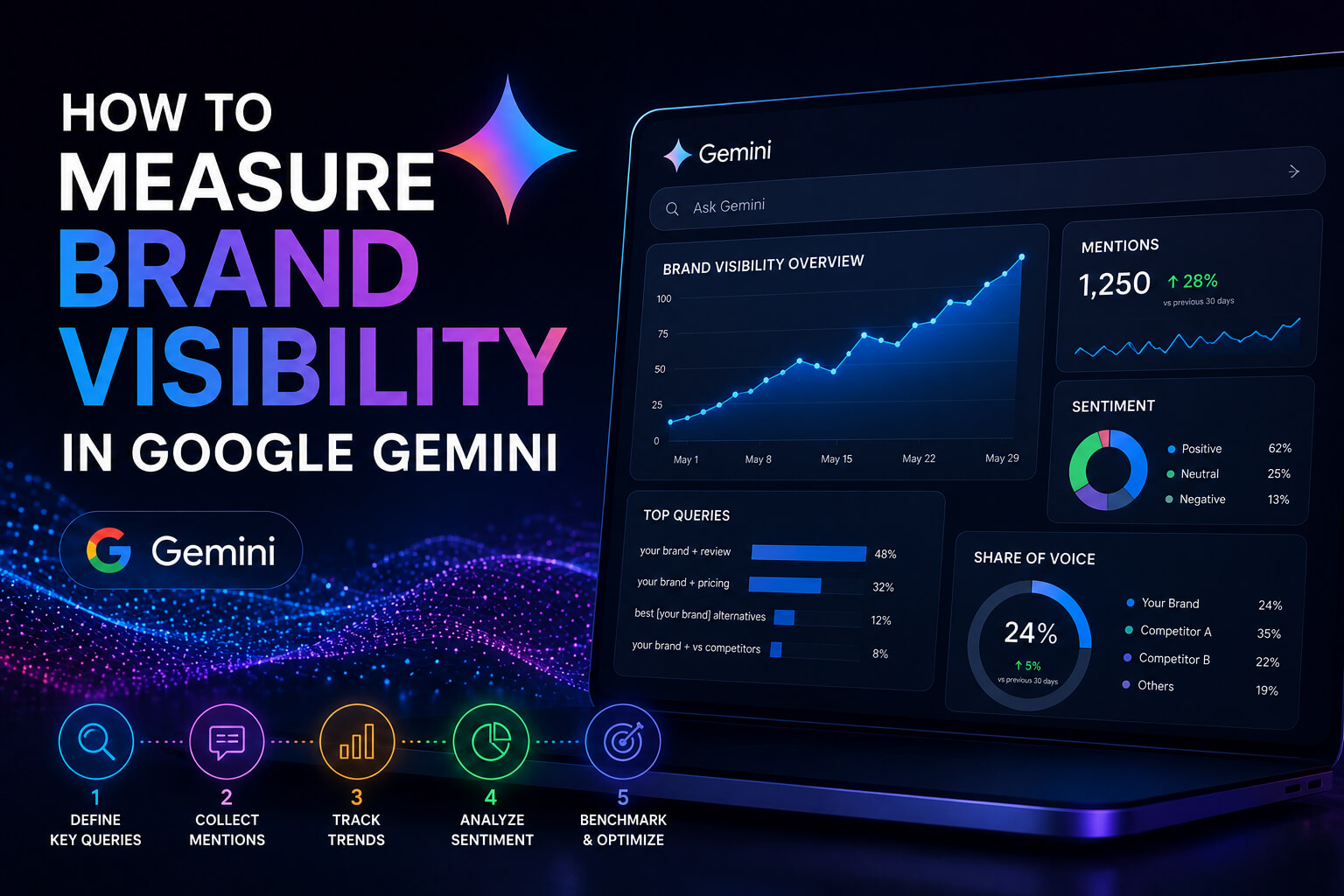
Google Gemini may be introducing customers to a brand long before that company sees a click, website visit or conversion.
That creates a measurement problem.
A potential buyer could ask Gemini for product recommendations, discover a company in the response and then continue researching elsewhere. Days later, that same person might visit the company’s website directly or search for its name on Google.
Analytics would record the final visit. The Gemini interaction that started the journey could disappear completely.
For marketers trying to measure brand visibility in Google Gemini, standard SEO reports no longer tell the whole story.
Gemini Mentions Do Not Appear in Standard SEO Reports
Google Search Console can show impressions, clicks and search queries. Google Analytics can track visits, engagement and conversions.
Neither platform provides a complete report showing how often Gemini mentions, recommends or compares a brand.
Gemini is also less predictable than a traditional search results page. Responses may change based on the wording of a prompt, the user’s location, previous questions, personalisation settings and updates to Google’s underlying AI models.
Two people can type nearly identical questions and receive different recommendations.
This means businesses cannot rely on a single Gemini search and call it a ranking. They need to watch patterns across a larger group of prompts.
The useful questions are fairly simple: How often does the brand appear? Which competitors appear beside it? Is Gemini describing the business accurately? Does that visibility improve over time?
Start With a Library of Customer Prompts
Manual prompt tracking remains one of the clearest ways to understand how Gemini presents a company.
The first step is building a list of questions that real customers might ask during different stages of a purchase.
Early-stage prompts may cover broad categories, such as “best accounting software for small businesses” or “what is an endpoint detection platform?”
Customers closer to making a decision may ask for comparisons, alternatives, pricing information or recommendations for a specific industry.
A useful prompt library should include branded questions, competitor comparisons, product use cases, local searches and common follow-up questions.
That last part matters. Gemini conversations often continue across several turns. A company may not appear in the first answer but could be introduced after the user narrows the request.
Record More Than a Simple Brand Mention
A spreadsheet showing “mentioned” or “not mentioned” provides a starting point, but it misses most of the useful information.
Businesses should also record where the brand appeared in the response, which competitors were included, what sources Gemini cited and whether the product description was accurate.
The tone of the mention matters too.
Gemini could recommend a brand strongly, include it as a secondary option or mention it while highlighting a weakness. All three count as visibility, but they do not carry the same business value.
Citation tracking can reveal another layer. When Gemini repeatedly links to a particular guide, product page or third-party review, marketers gain a clue about which sources Google’s AI considers useful for that topic.
Those pages may deserve an update, stronger supporting information or clearer brand positioning.
Gemini Visibility Needs Repeated Testing
A single test is little more than a snapshot.
Gemini answers change as Google updates its models, competitors publish new material and websites revise their content. The same prompt may also produce a slightly different answer during another session.
High-priority prompts in competitive sectors may need weekly monitoring. Monthly checks could be enough for businesses in slower-moving markets.
The goal is not to panic whenever a brand disappears from one response. Marketers should look for sustained changes in mention frequency, competitor position, citations and overall messaging.
Research into generative search measurement has also warned that one-time observations can create misleadingly precise results because AI answers vary across repeated runs.
AI Visibility Tools Can Handle Larger Prompt Sets
Manual tracking works when a team is monitoring a few dozen prompts. It gets messy once that list reaches hundreds or thousands.
AI visibility platforms are beginning to automate much of the process.
Tools including Profound, Scrunch AI, Otterly.AI and Peec AI can monitor prompts and compare brand performance across AI search platforms. Established SEO providers such as Semrush and Ahrefs have also introduced AI visibility features.
Depending on the platform, marketers may be able to track answer inclusion rates, citation frequency, competitive share of voice, response position and historical visibility.
That makes it easier to spot broader movement instead of checking every Gemini answer by hand.
These tools still have limits. They generally run a fixed collection of prompts under controlled conditions. They cannot reproduce every user’s location, conversation history, account settings or personalised Gemini experience.
The data is best treated as a consistent benchmark, not a perfect recreation of what every customer sees.
Website Analytics Can Reveal Gemini’s Business Impact
Visibility tracking shows whether a brand appears in Gemini. Analytics helps determine whether that exposure leads anywhere.
Some Gemini responses include links that send users directly to websites. Those visits can be measured through referral traffic, landing-page engagement, conversions and assisted conversions.
Direct referrals may represent only a small part of Gemini’s influence.
A user might see a recommendation, remember the company name and return through a branded Google search. Another person could type the website address directly. Neither journey clearly identifies Gemini as the original discovery point.
Marketers should therefore watch for indirect signals, including growth in branded search volume, direct traffic, assisted conversions and stronger performance from pages Gemini frequently cites.
None of those figures proves Gemini caused the increase by itself. Taken alongside improving prompt visibility, however, they can provide a more believable picture of AI-assisted discovery.
Brand Accuracy Is Becoming Part of Website Strategy
Measuring visibility is not only about counting mentions.
Businesses also need to check whether Gemini understands what they sell, who they serve and how their products differ from competitors.
Outdated service pages, inconsistent company descriptions and weak third-party coverage can leave AI systems working with an incomplete picture.
Website teams may need to treat brand information more like structured data: clear product descriptions, consistent company details, updated pricing information, visible expertise and supporting evidence from credible external sources.
Traditional SEO still matters. Strong pages, crawlable content and recognised authority can help AI systems find and interpret a brand.
The difference is that the result may now appear inside a generated answer rather than as a familiar blue link.
Gemini Visibility Measures Consideration Before the Click
Search marketing has usually focused on measurable outcomes: rankings, visits, leads and sales.
Gemini creates another layer before those actions happen.
A company can now appear while a customer is still forming a shortlist, comparing options or trying to understand a market. That early influence may not create an immediate visit, but it can shape what happens later.
For website owners, this changes what visibility means.
Being found is no longer limited to ranking on a results page. It also means being recognised, described correctly and recommended when an AI system answers the customer’s question.
Sources
- Search Engine Land
- Search Engine Land AI Visibility Guide
- Research paper — Don’t Measure Once: Measuring Visibility in AI Search
- Research paper — Quantifying Uncertainty in AI Visibility